Unetwork Formerly Unity Nodes: What Changed for Operators?

Updated: Jul 10

↓

If you searched for Unetwork formerly Unity Nodes, the answer is straightforward. Unity Nodes rebranded to Unetwork. The technology is the same. The licenses are the same. The earning model is the same. What changed is the name, the app branding, and the public identity of the network — not the work your device does or how rewards are calculated.
For operators already running the app, that is the most important thing to know. For anyone still deciding whether to join, it means you are looking at a network that has been operating since before the rebrand and is now expanding under a cleaner, more globally recognisable identity.
What was Unity Nodes
Unity Nodes was the original name for what is now Unetwork — a distributed telecommunications verification network that turns everyday smartphones into part of a global edge network. Users joined as License Operators, installed the app on a compatible Android or iOS device, and earned rewards by keeping their phone online and stable while it completed background network verification tasks.
The model was built around real utility. Carriers and enterprises paid service fees for access to telemetry data, signal quality checks, and connectivity verification across real devices in real locations. Rewards flowed from those fees rather than from token emissions — which is why stable uptime was always the core requirement for operators.
The network's first public Android APK was released on November 7, 2025, marking the start of operator access under the Unity Nodes name.
Why the name changed
No official statement from Unetwork explaining the reason for the rebrand has been published. The most widely discussed explanation among the operator community is the potential for confusion with Unity Technologies — the NYSE-listed San Francisco game engine company that holds registered trademarks on the Unity name across software and technology categories, dating back to 2005.
Unity Technologies is one of the most widely recognised names in the global games industry, and an app called Unity running background processes on mobile devices created an obvious naming conflict in search, app stores, and user perception.
Whether trademark pressure was the direct cause or simply the most obvious practical reason, the outcome is the same. The network now operates under the Unetwork name, the app has been updated accordingly, and the transition has been treated as a straightforward rename rather than a structural change to the program.
What stayed exactly the same
Everything that matters for operators remained unchanged after the rebrand. The earning logic is the same — rewards scale with device uptime, and close to 100% uptime earns significantly more than 80%. The license structure is the same — License Operators participate through the app, and Node Operators sit at the infrastructure level with 200 Operator Licenses attached to each Node.
The technology is the same — verification results are hashed to WMChain for on-chain auditability, and no SIM calls are made, no contacts accessed.
The partners are the same. Unetwork still operates in partnership with World Mobile, Minutes Network and ShuftiPro. The reward source is the same — service fees paid by carriers and enterprises, not token inflation.
For operators, the practical focus has not changed either. Keep your device online and stable. Keep the app updated. Avoid battery optimisation settings that close background activity. Those habits produced results before the rebrand and continue to produce results after it.
What is new under the Unetwork brand
The rebrand has coincided with a significant expansion of official communication and platform development.
In June 2026, Unetwork launched its official YouTube channel, announced fiat bank transfer withdrawals as a live payout option, confirmed that Windows and macOS desktop installers are in development, named its first cohort of founding ambassadors, and introduced Entropy in app version 1.2.1 — a new task that generates verified randomness for enterprise clients, detailed further below.
Unetwork CMO Jamie King on the network's mission and global expansion
Fiat withdrawals being live is the most important of these for everyday operators. It means rewards earned through device uptime can now be withdrawn directly as traditional money — not just digital payments. That removes a significant barrier for operators in markets like India, Nigeria, the Philippines, Pakistan, and Bangladesh who want a direct path from background participation to local bank account.
Digital withdrawals remain available from just 5 USD. Fiat bank transfers are available from 200 USD.
How Unetwork tasks work
Unetwork devices perform network verification tasks in the background. Understanding what each task actually does — and how to complete it correctly — is one of the most overlooked aspects of running a license effectively.
Connection to Unetwork
This is the baseline task that runs continuously whenever the app is active. It keeps your device connected to the Unetwork edge network and contributes to the overall verification layer. It is always active by default and requires no action from you. Stable WiFi and correctly configured battery settings are what keep this task performing consistently.
CLI tasks — Caller ID Testing
This is the task most commonly misunderstood by operators. Most assume CLI means answering a phone call. It does not.
CLI stands for Caller Line Identification. When a CLI task is triggered, a test call is routed to your device through the real telecom network. Your phone displays an incoming call with a number. Your job is to report that number exactly as it appeared on your screen — and then the task is complete. You do not pick up. You do not speak to anyone.
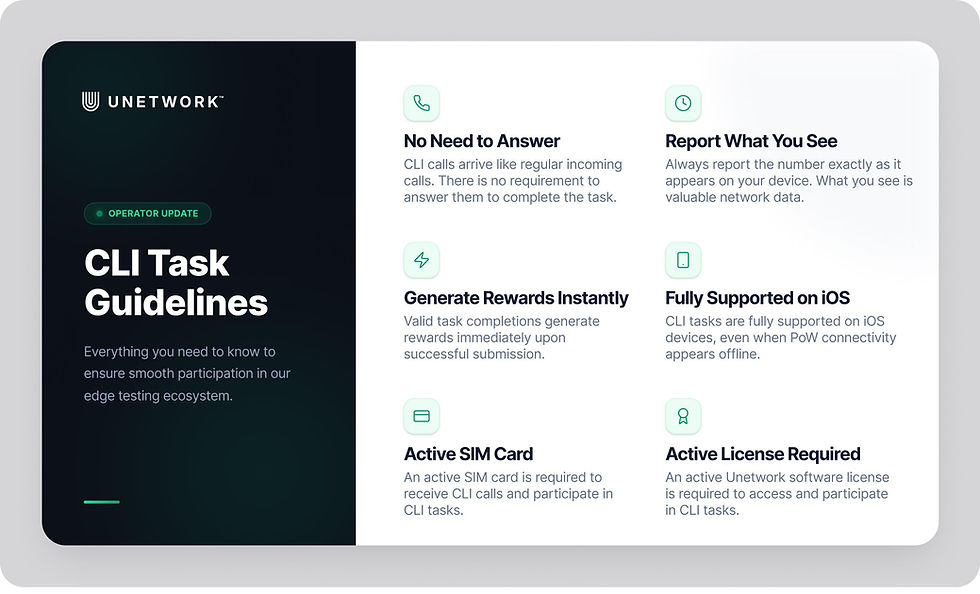
Missing the call does not automatically mean missing the task. CLI tasks include a reporting window that gives you time to submit your report after the call event has occurred.
What matters for CLI tasks:
Your device needs an active SIM card to receive CLI calls. iOS devices are fully supported for CLI tasks, even when the Proof-of-Work connectivity indicator appears offline. If the number displayed on your screen looks unusual or unexpected, report it exactly as you see it — your job is to log what you received, not to judge whether the number looks correct. Rewards generate immediately upon valid task completion.
The reason CLI testing exists is to verify real-world call delivery across carrier networks. Carriers and enterprises pay for data on whether their calls are actually reaching devices, whether routing is consistent, and whether numbers are being delivered accurately across real locations. Each report from a real device in a real location contributes to that picture.
Unusual or unexpected numbers are not errors — they are precisely the kind of data the network needs to identify routing inconsistencies and improve telecom infrastructure visibility.
If a CLI call arrives while you are busy, do not worry. Submit your report within the reporting window. The more accurately operators report, the more effective the network becomes.
Connectivity Verification
Connectivity Verification is live in the app. As a passive background task, it checks and reports signal strength in your local area, expanding the range of real-world telemetry Unetwork delivers to carrier and enterprise partners — running automatically alongside Connection and CLI, with no action required from you.
Connectivity Verification is also the entry point for operators who want to do more. Opening the Connectivity Verification tab in the app's Tasks section is how you access Scout and Runner — see below.
Entropy
Entropy is a new task introduced in Unetwork app version 1.2.1. Unlike Connection or CLI, which measure device and network performance, Entropy generates high-quality randomness for use cases where secure, verifiable randomness has real commercial value — including cryptography and security, blockchain verifiable random functions, fintech, gaming and lotteries, and regulated industries. By combining entropy contributions from a large number of independent devices, Unetwork is building a distributed source of randomness for these use cases.
It's worth understanding where Entropy currently sits in its rollout. The part of the system that runs on your device — the Entropy Collection Layer — has completed its audit and is approved for production, which is why the task is available now. The Delivery and Settlement layers that handle commercial delivery to enterprise clients are still completing their own independent audits. In practical terms, Entropy is operational at the collection and validation stage, not yet at full commercial scale — task availability and commercial maturity are two different things. Early rewards reflect this ramp-up phase rather than the task's longer-term earning potential. Entropy rewards are tracked separately from Telemetry rewards, though the app doesn't yet display them under a distinct label in the interface. Entropy is currently available on Android only.
Scout and Runner
Beyond these background tasks, Unetwork also offers Scout and Runner — an active-earning, opt-in program for operators who want to participate more directly. It's provided as a third-party task by APEX Telecom and accessed through the Connectivity Verification tab described above. Scout & Runner is in full public Beta. For the full breakdown of how the Scout and Runner roles work, see our FAQ.
What Unetwork formerly Unity Nodes means for operators
For existing operators, the rebrand requires no action beyond keeping the app updated to the current version. Your account, your license, and your earning history carry across. If you see updated terminology in the app — Unetwork instead of Unity Nodes — that is the transition being reflected in the interface, not a structural change to how rewards work.
For new operators joining now, the rebrand actually makes the onboarding clearer. The Unetwork name is distinct, the official YouTube channel provides video walkthroughs, and the fiat withdrawal option makes the earning journey easier to trust from day one.
The one area to watch is app version. Outdated versions may still display older Unity branding that no longer matches support documentation. Keeping the app current ensures your device is running the latest verification protocols and displaying accurate status information.
How to join as a License Operator through EarnInUnity
EarnInUnity is an independent community platform that onboards everyday smartphone users into the Unetwork License Operator program.
Joining through EarnInUnity gives you access to a 12-month lease — public marketplace leases start at 1 month — and License Operators earn 10% above the highest public marketplace rate. Daily rewards scale with uptime — close to 100% uptime earns significantly more than 80%.
Setup is designed for everyday mobile users. You sign up, receive your license code, download the Unetwork app, activate your operator role, and let the app run in the background.
The complete setup — from downloading the app to confirming all three green status indicators — is covered step by step in the official Unetwork video guide. Most videos are under one minute.
For those who want to participate at the infrastructure level, the Unetwork Node Operator program offers a higher-tier position within the same network. EarnInUnity offers $500 cashback on every Node purchase made through the EarnInUnity referral link.
The complete Node Operator setup — from connecting your Web3 wallet to configuring license defaults and generating lease codes — is covered step by step in the official Unetwork Node Operator video guide. Most videos are under one minute.
The operators who earn most consistently are those who completed the setup fully, configured their battery settings correctly, and kept their device connected to WiFi overnight. That combination — full activation, correct settings, stable connection — is the entire formula.
Your Phone Is Ready. Are You?
Rewards start accumulating from day one.
Digital rewards can be withdrawn from just 5 USD.
Bank transfer to your local account is available from 200 USD.
EarnInUnity members earn 10% above Unetwork's public marketplace rates, guaranteed.
The complete technical guide to Unetwork is on Medium. Read it here→
Everything answered. Full FAQ
Official Unetwork resources